
China's space ambitions are reshaping the global technological landscape, blending artificial intelligence with satellite networks to challenge American dominance. The deployment of Wukong AI on the Tiangong space station marks a significant milestone in AI-assisted spaceflight, enhancing crew safety and reducing dependence on ground control. Meanwhile, DeepSeek's upgraded AI model supports domestically produced chips, advancing China's technological self-sufficiency. The rapid deployment of the Guowang satellite network, potentially designed for military purposes, further demonstrates China's strategic vision. With plans to expand to nearly 13,000 satellites, this constellation could form the backbone of a space-based military command and control network. China's state-directed approach, coupled with substantial investments in AI development, reflects a comprehensive strategy to overcome U.S. export restrictions and achieve technological independence. As these advancements mature, they will inevitably reshape international relations, military strategy, and the
In the vast expanse of space, a new technological revolution is unfolding as China deploys sophisticated artificial intelligence systems and satellite networks that signal a profound shift in the global space race. From AI assistants on space stations to ambitious satellite megaconstellations, China’s strategic investments reveal a comprehensive plan to achieve technological self-reliance while challenging American dominance in these critical domains.
The recent deployment of Wukong AI on China’s Tiangong space station marks a significant milestone in the integration of artificial intelligence with human spaceflight. Named after the legendary Monkey King from Chinese mythology, this AI assistant recently supported three taikonauts during their third spacewalk, representing the first time China has applied and verified large-scale AI model technology in space. According to reports from China Daily, Wukong AI combines both ground and space models in an intelligent question-answering system, providing real-time support for complex operations that previously required extensive human oversight. For those interested in smart AI assistants, the GILOBABY Robot Toys Smart Talking Robot offers a simplified interactive experience with voice control and intelligent responses.
What makes Wukong particularly noteworthy is its ability to function autonomously in the challenging environment of space, where communication delays with Earth can complicate mission operations. The AI chatbot serves as more than just a convenience—it represents a strategic capability that enhances crew safety while potentially reducing dependence on ground control for moment-to-moment decision-making. According to the China Astronaut Research and Training Center, the system “can provide rapid and effective information support for complex operations and fault handling by crew members, improving work efficiency, in-orbit psychological support and coordination between space and ground teams.”
Meanwhile, on the terrestrial front, Chinese AI startup DeepSeek has recently unveiled an upgraded V3.1 model that integrates support for domestically produced chips—a critical advancement in China’s push toward technological self-sufficiency. This new version features optimizations specifically designed for Chinese-made processors, along with faster processing speeds that enhance its utility for both commercial and potentially military applications. DeepSeek’s technical documentation hints at compatibility with a new generation of Chinese AI chips that could reduce the country’s reliance on restricted foreign technologies. For those wanting to learn more about AI developments, Semantic SEO, SRO & AI provides insights into how artificial intelligence reads and processes information. According to reports, the previous V3 model was trained using 2,048 Nvidia H800 chips, but the new version demonstrates China’s progress toward developing alternative hardware solutions.
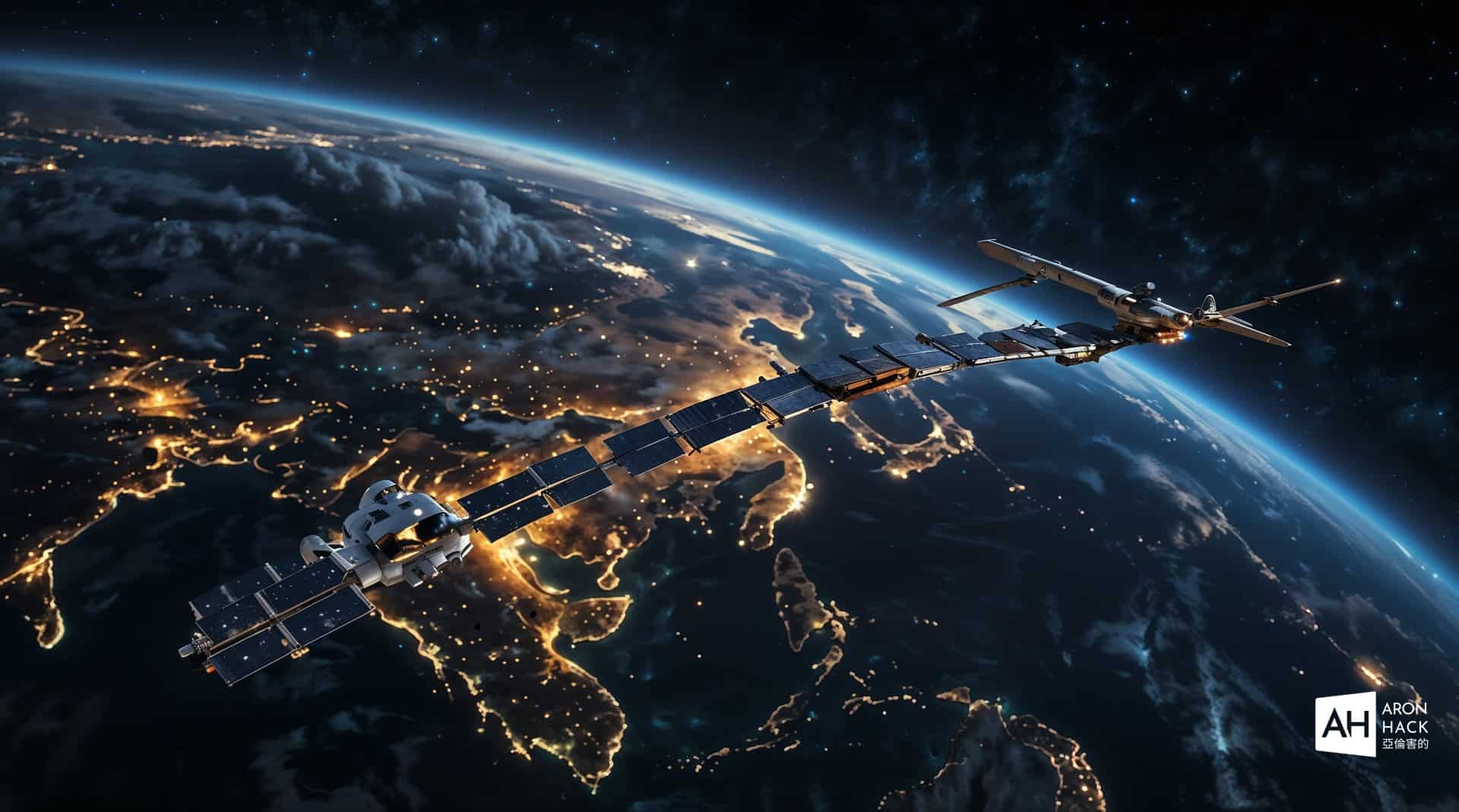
The timing of these advancements is particularly significant as China accelerates the deployment of its Guowang satellite network, which has placed 72 satellites into orbit since launches began in December 2024. Recent weeks have seen China’s pace of satellite deployment approach that of SpaceX’s Starlink, with multiple groups of Guowang satellites launched since late July 2025. Unlike Starlink, however, the Guowang constellation—which means “national network” in Chinese—appears designed for purposes beyond consumer broadband services.
Analysis from Ars Technica suggests that Guowang may be more comparable to the U.S. military’s proposed MILNET system or SpaceX’s military-grade Starshield satellites than to commercial internet services. The constellation’s architecture potentially supports a variety of payloads, including synthetic aperture radars, optical remote sensing equipment, and laser communication terminals that could form the backbone of a space-based military command and control network. China’s long-term plan reportedly includes expanding the Guowang constellation to nearly 13,000 satellites, with a milestone of 400 satellites by 2027. Space enthusiasts can explore celestial objects using a Portable Astronomical Telescope for stargazing and planetary observation.
The strategic implications of these developments extend far beyond scientific achievement. U.S. Space Force General Chance Saltzman expressed concern during Senate testimony that China’s space-enabled targeting capabilities “increased the range and accuracy of their weapon systems to the point where getting anywhere close enough in the Western Pacific to be able to achieve military objectives is in jeopardy.” This assessment underscores how space-based assets are increasingly viewed as critical components of national security infrastructure rather than merely scientific or commercial ventures.
China’s approach differs fundamentally from the U.S. model. While American space capabilities have increasingly relied on partnerships with private companies like SpaceX, China has pursued a more state-directed strategy involving numerous commercial and government-backed enterprises. This diversified approach may lack the efficiency of having a single dominant player like SpaceX, but it demonstrates remarkable resilience against potential disruptions while fostering innovation across multiple sectors of the space economy. For educational purposes, the Science Can Solar System Model Kit provides an interactive way to learn about planetary systems and space exploration.
The push for technological self-reliance extends beyond hardware to encompass the entire AI ecosystem. Shanghai recently announced a one billion yuan (approximately $139 million) subsidy program for its artificial intelligence industry, adding to similar investments across major Chinese cities. According to Pan Helin, a member of an expert committee under China’s Ministry of Industry and Information Technology, strong funding represents one of Shanghai’s key advantages in AI development. These investments reflect China’s determination to overcome U.S. export restrictions on advanced semiconductors and related technologies that have targeted its AI ambitions.
The competition between these approaches—American technological restrictions versus Chinese self-reliance investments—may ultimately determine which nation gains the upper hand in these strategically vital technologies. Rather than a simple race with a clear finish line, the situation increasingly resembles a complex ecosystem where different models of innovation and deployment compete and occasionally complement one another.
For international observers, these developments highlight the growing interdependence between artificial intelligence and space technology. As Brigadier General Anthony Mastalir, commander of U.S. Space Forces in the Indo-Pacific region, noted, China’s specific goals appear to include the ability “to track and target US high-value assets at the time and place of their choosing.” This capability requires not just satellites but the advanced AI systems to process the vast amounts of data they collect—precisely the technologies China is now developing domestically.
As these technologies mature, they will inevitably reshape international relations, military strategy, and the future of human space exploration. The integration of AI with space systems creates unprecedented capabilities for monitoring Earth, coordinating complex operations, and potentially establishing a permanent human presence beyond our planet. How nations choose to develop and deploy these technologies will profoundly influence geopolitics for decades to come.
What remains clear is that space is no longer the exclusive domain of a few superpowers or specialized agencies. Instead, it has become an arena where artificial intelligence, satellite technology, and strategic ambition converge to create new capabilities and challenges. In this environment, China’s determined pursuit of technological self-reliance represents not just a response to external pressure but a comprehensive strategy to reshape the global technological landscape according to its own vision and values.
The celestial integration of intelligence—both human and artificial—may ultimately prove to be one of the defining developments of our age, with implications far beyond the orbits where these technologies currently operate.


